What Is a Marketing Agency?
Introduction
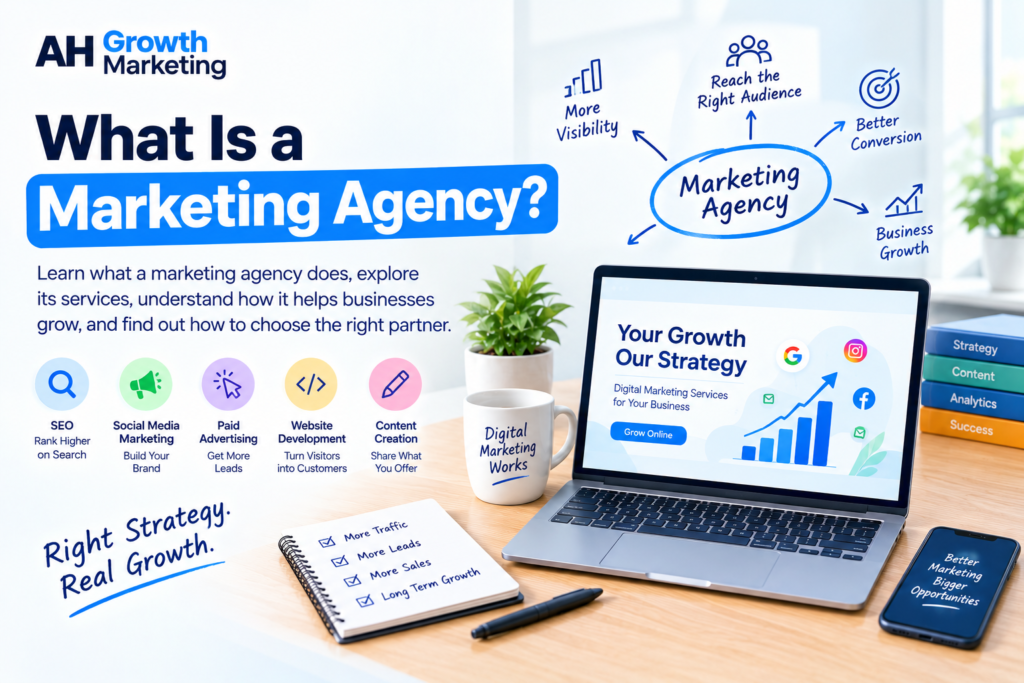
What is a marketing agency, and why do businesses hire one? A marketing agency helps businesses promote their products or services, reach potential customers, build brand awareness, and generate sales. Depending on its expertise, an agency may handle digital marketing, traditional advertising, content creation, or a combination of these activities.
Imagine launching a great product but telling almost nobody about it. Your product might be excellent, but potential customers cannot buy something they do not know exists. Unfortunately, hoping people will magically discover your business is not much of a marketing strategy.
However, hiring an agency does not guarantee success. Results depend on the quality of the strategy, your offer, the market, your budget, and how well your business serves customers.
Table of Contents
What Is a Marketing Agency?
What Services Does a Marketing Agency Provide?
How Does a Marketing Agency Work?
Benefits of Hiring a Marketing Agency
Marketing Agency vs Advertising Agency
How to Choose the Right Marketing Agency
Common Mistakes to Avoid
Frequently Asked Questions
Conclusion
1. What Is a Marketing Agency?
Its main purpose is to help businesses communicate their value to potential customers. Some agencies specialize in a particular service, such as search engine optimization, while others provide a wider range of marketing solutions.The agency’s responsibilities depend on the agreement with the client.
A good agency does more than publish posts or create attractive advertisements. It tries to understand the business, identify the target audience, select suitable channels, and measure performance against clear objectives.
2. What Services Does a Marketing Agency Provide?
Marketing agencies offer different services based on their skills and the needs of their clients.
Digital Marketing
Digital marketing includes online activities that help businesses reach customers through search engines, websites, email, and social media.
Services may include SEO, paid advertising, content marketing, email marketing, and online campaign management.
Search Engine Optimization
SEO helps improve a website’s visibility in organic search results. It involves keyword research, content optimization, technical improvements, internal linking, and other activities that help search engines understand a website.
For example, a website development company might publish a detailed service page to help potential customers understand its services and find it through relevant searches.
SEO requires consistent effort, and no agency can honestly guarantee a specific Google ranking.
Social Media Marketing
Social media marketing helps businesses communicate with audiences through platforms such as Facebook and Instagram.
An agency may plan content, design graphics, manage publishing schedules, respond to relevant interactions, and run paid social campaigns.
The goal should be clear. Depending on the business, success may mean more qualified enquiries, stronger brand awareness, website visits, or sales.
Paid Advertising
Paid advertising uses platforms such as Google Ads and Meta Ads to promote products or services.
Agencies may manage audience research, campaign setup, advertisement creation, conversion tracking, and budget optimization.
Campaign performance should be measured against business goals rather than clicks alone.
Website Development and Content Creation
Some agencies also build websites, improve landing pages, write blog articles, and create marketing graphics.
These services can support a broader strategy by helping customers understand an offer and take the next step.
3. How Does a Marketing Agency Work?
A marketing agency usually follows a structured process.
Step 1: Understand the business. The agency learns about your products, audience, competition, budget, and goals.
Step 2: Research the market. It examines customer needs, relevant search terms, competitors, and suitable marketing channels.
Step 3: Create a plan. The strategy outlines recommended services, responsibilities, timelines, and performance measures.
Step 4: Execute the work. Depending on the agreement, the agency may manage campaigns, create content, improve the website, or run advertising.
Step 5: Review the results. It uses available data to evaluate performance and identify possible improvements.
For example, a coaching institute that wants more student enquiries might improve its course pages, publish useful educational content, and test paid advertising. The agency could then track qualified enquiries and the cost of generating them.
This is an illustrative example, not a claim of guaranteed results. Actual performance should be measured using verified campaign data.
4. Benefits of Hiring a Marketing Agency
Access to Specialist Skills
Marketing may involve SEO, design, advertising, writing, and analytics. An agency can provide access to several skills without requiring a business to recruit a separate full time employee for every role.
A Clearer Marketing Strategy
A structured plan connects marketing activities with business goals. This is more useful than posting content simply because the calendar says something needs to be published.
Performance Tracking
Agencies can use analytics tools to monitor website traffic, enquiries, conversions, and advertising costs. Reliable measurement helps businesses make better decisions.
Time Savings
Outsourcing selected marketing activities can allow business owners to focus on operations, products, and customer service.
However, businesses should remain involved in important decisions and understand how their marketing budget is being used.
5. Marketing Agency vs Advertising Agency
A marketing agency often covers several parts of the marketing process, including research, positioning, content, SEO, social media, and campaign planning.
An advertising agency traditionally focuses more on creating and distributing advertisements through channels such as television, print, radio, and digital advertising platforms.
In practice, the services often overlap. Some advertising agencies provide complete digital marketing services, while some marketing agencies specialize in paid campaigns.
When comparing providers, focus on what they actually do rather than relying only on the company name.
6. How to Choose the Right Marketing Agency
Before hiring an agency, consider these factors.
Check relevant experience. Review projects, portfolios, and case studies related to your industry or goals.
Understand the services. Confirm that the agency offers the services your business needs.
Ask about measurement. Find out which metrics it tracks and how it evaluates success.
Compare pricing. Understand management fees, advertising costs, deliverables, and additional charges.
Check communication. Ask who will manage your work and how often progress will be reported.
Avoid unrealistic promises. Be cautious of guaranteed rankings, instant growth claims, or promised sales without a clear explanation.
Your business should also retain appropriate access to its website, advertising accounts, and analytics.
7. Common Mistakes to Avoid
Choosing an agency only because it offers the lowest price can lead to a poor fit. At the same time, a high fee does not automatically prove expertise.
Another mistake is expecting immediate results from every marketing channel. Paid advertising can produce early data, while SEO often needs sustained effort.
Businesses should also avoid focusing exclusively on followers, impressions, or clicks when their real goal is sales or qualified leads.
Finally, do not approve a marketing strategy without understanding its objectives, costs, and measurement process.
8. Frequently Asked Questions
A marketing agency helps businesses promote their products or services through research, strategy, content creation, SEO, social media, advertising, and other marketing activities.
A marketing agency may manage a wider range of activities, while an advertising agency often focuses on planning and delivering advertisements. Their services can overlap.
Costs vary according to services, workload, competition, and campaign complexity. Request a written proposal that clearly explains the fees and deliverables.
Yes. Small businesses may use agencies for local SEO, website development, social media marketing, content creation, or paid advertising, depending on their goals and budget.
Review relevant experience, understand the proposed strategy, compare pricing, ask about reporting, and check whether the agency can explain how it plans to measure results.
9. Conclusion
A marketing agency helps businesses reach potential customers through planned and measurable marketing activities. Its services may include SEO, social media marketing, paid advertising, content creation, and website development.
The right agency understands your business goals, explains its recommendations, and measures results using relevant data. Before hiring one, check its experience, clarify the costs, and agree on what success means for your business.
Marketing is not about making the most noise. It is about reaching the right people with a message that gives them a reason to act.
Want to understand how digital marketing can support your business? Explore the SEO, paid advertising, social media marketing, and website development resources from AH Growth Marketing to identify practical next steps for your online growth.