
What Is Digital Marketing Strategy?
Introduction
A business can spend money on SEO, social media, Google Ads, and content creation without getting meaningful results. The problem is not always the marketing channels. Sometimes, the business simply has no clear plan.
A digital marketing strategy gives your marketing activities a clear direction. It helps you decide who you want to reach, what message to communicate, which platforms to use, and how to measure success.
For example, a local service business that wants more enquiries may need local SEO, a well designed website, and targeted advertising. An online store may focus more on product SEO, shopping campaigns, and remarketing.
The right approach depends on your audience, budget, competition, and business goals. This guide explains how digital marketing strategy works and how to build one for your business.
Table of Contents
What Is a Digital Marketing Strategy?
Why Is a Digital Marketing Strategy Important?
Key Elements of a Digital Marketing Strategy
How to Create a Digital Marketing Strategy
Common Digital Marketing Strategy Mistakes
How to Measure Marketing Performance
Frequently Asked Questions
Conclusion
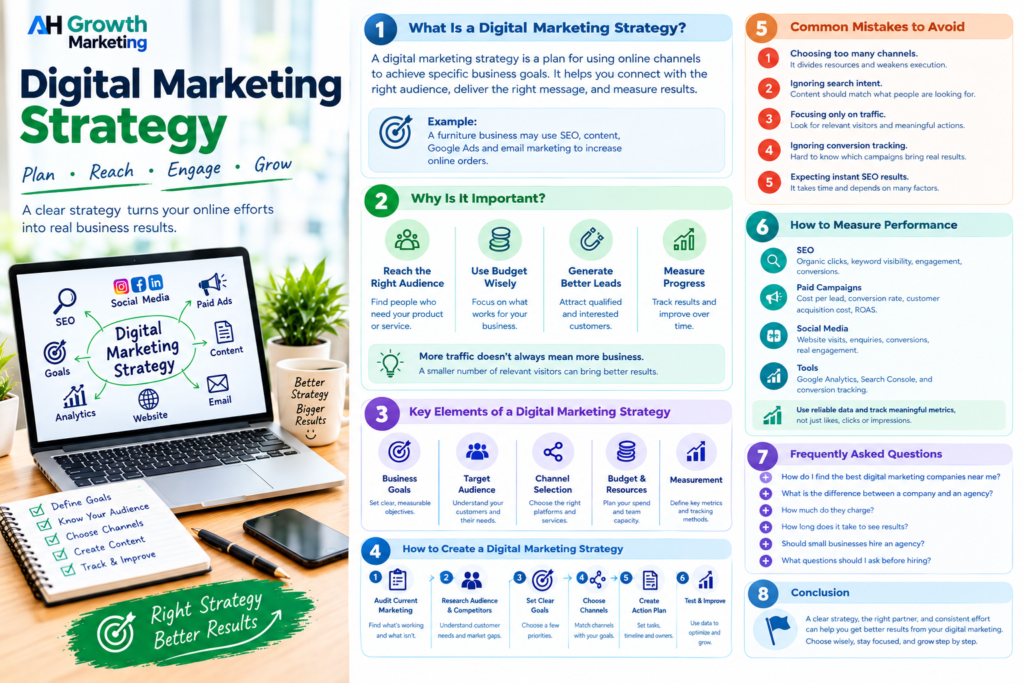
1. What Is a Digital Marketing Strategy?
A digital marketing strategy is a plan for using online channels to achieve specific business goals. These channels may include search engines, websites, social media platforms, email, and paid advertising.
The purpose is to connect the right audience with the right message at the right time.
Consider a business that sells handmade furniture. Its goal is to increase online orders. Its strategy might include creating SEO friendly product pages, publishing furniture care guides, running Google Ads for high intent searches, and collecting customer emails for future promotions.
Each activity supports the same business objective.
A strategy is different from a list of marketing tasks. Posting on Instagram every day is an activity. Using Instagram to reach a defined audience, test product messaging, and direct interested users to relevant landing pages is part of a strategy.
2. Why Is a Digital Marketing Strategy Important?
Without a clear plan, businesses often spread their budget across too many channels. They may publish content without researching keywords or run advertisements without tracking conversions.
A well planned strategy helps businesses:
Reach the Right Audience
Audience research helps identify customer needs, interests, location, and buying behaviour. This makes marketing messages more relevant.
Use the Budget Wisely
A small business may not need to invest in every marketing channel. It can start with the channels most likely to support its immediate goals.
Generate Better Leads
Targeted campaigns and useful content can attract people who are more likely to need the product or service.
Measure Progress
Defined goals make it easier to understand which campaigns generate enquiries, sales, or other valuable actions.
Practical insight: More website traffic does not automatically mean more business. A campaign attracting 500 relevant visitors may produce better results than one attracting 5,000 visitors who have little interest in the offer.
3. Key Elements of a Digital Marketing Strategy
A strong strategy connects several important elements.
Business Goals
Start by deciding what you want to achieve. Common goals include increasing sales, generating qualified leads, improving brand awareness, and growing organic traffic.
Make goals measurable. Instead of saying, “We want more leads,” define a target and timeframe based on your current performance and available resources.
Target Audience
Understand who your potential customers are and what problems they want to solve.
Useful research includes customer questions, search terms, website analytics, sales conversations, and competitor content. Avoid relying entirely on assumptions.
Channel Selection
Choose channels based on audience behaviour and business objectives.
For example:
SEO: Useful for attracting people searching for relevant information, products, or services.
Performance marketing: Helps businesses reach targeted audiences through paid campaigns and measure conversions.
Social media marketing: Supports audience engagement, brand awareness, and product discovery.
Content marketing: Educates potential customers and answers their questions.
Email marketing: Helps businesses nurture existing leads and maintain customer relationships.
Not every business needs every channel immediately.
Budget and Resources
Set a realistic budget for advertising, content production, website improvements, and marketing tools. Consider the time required to manage each channel as well.
Measurement
Decide how success will be evaluated before launching campaigns. Depending on your goals, useful metrics may include qualified leads, conversion rate, customer acquisition cost, organic clicks, and return on advertising spend.
4. How to Create a Digital Marketing Strategy
A practical digital marketing planning process can be divided into six steps.
Step 1: Audit Your Current Marketing
Review your website, search visibility, social media activity, paid campaigns, and existing conversion data.
Identify what is working, what needs improvement, and where potential customers are dropping out of the buying process.
Step 2: Research Your Audience and Competitors
Study the search terms customers use, the questions they ask, and the solutions competitors offer.
For example, a web development agency may discover that potential customers search for website costs, delivery timelines, and maintenance services. These findings can guide its content and landing pages.
Step 3: Set Clear Goals
Choose a small number of priorities. A business focused on lead generation might aim to increase qualified enquiries, while an online store may focus on profitable sales.
Use existing data to set realistic targets instead of choosing numbers without evidence.
Step 4: Choose Your Marketing Channels
Select channels that match your audience and goals. If customers frequently search Google for your services, SEO and search advertising may deserve attention. If customers discover products through visual content, social media could play a larger role.
Step 5: Create an Action Plan
Prepare a schedule for content publishing, campaign launches, landing page improvements, and performance reviews.
Assign responsibilities and establish deadlines so that the strategy becomes an actual working plan.
Step 6: Test and Improve
Review performance regularly. Pause campaigns that consistently waste budget, improve weak landing pages, and test different messages when the data supports experimentation.
A strategy should evolve as customer behaviour and business priorities change.
5. Common Digital Marketing Strategy Mistakes
Several mistakes can reduce marketing effectiveness.
Choosing too many channels: Managing every platform at once can divide resources and weaken execution.
Ignoring search intent: A blog targeting an informational keyword should answer the reader’s question rather than immediately pushing a sales message.
Focusing only on traffic: Visitors are useful when they match the audience and take meaningful actions.
Ignoring conversion tracking: Without reliable tracking, it becomes difficult to identify which campaigns generate valuable outcomes.
Expecting instant SEO results: Organic search growth takes time and depends on competition, website quality, content relevance, and other factors.
The best approach is to start with clear priorities, measure performance, and improve based on evidence.
6. How to Measure Marketing Performance
Your metrics should reflect your business goals.
For SEO, monitor organic clicks, relevant keyword visibility, landing page engagement, and conversions from organic search.
For paid campaigns, review cost per lead, conversion rate, customer acquisition cost, and return on advertising spend where reliable revenue data is available.
For social media, look beyond likes. Track relevant website visits, enquiries, conversions, and engagement from your target audience.
Use tools such as Google Analytics and Google Search Console to understand website performance. Configure conversion tracking carefully and check that the collected data is reliable before making major budget decisions.
7. Frequently Asked Questions
It is a plan that explains how a business will use online channels to reach its audience and achieve goals such as sales, leads, or brand awareness.
Common approaches include SEO, content marketing, social media marketing, email marketing, paid advertising, and conversion rate optimization.
Start by identifying your ideal customers and main business goal. Review your existing marketing, choose a few suitable channels, create an action plan, and track results regularly.
The timeframe depends on the channel and competition. Paid campaigns can generate early data quickly, while SEO and content marketing generally require sustained work before meaningful results become visible.
Costs depend on the business, selected channels, competition, internal resources, and advertising budget. Begin with a realistic budget and increase investment when performance data supports it.
7.Conclusion
A digital marketing strategy helps businesses move from random online activities to focused marketing decisions. It connects business goals with audience research, channel selection, budget planning, and performance measurement.
Effective digital marketing planning does not require using every available platform. It requires understanding your customers, choosing the right priorities, and improving your approach using reliable data.
For AH Growth Marketing, the principle is straightforward: marketing activities should support a clear objective and be evaluated against meaningful business outcomes.
Need help planning your digital marketing activities?
Explore the services offered by AH Growth Marketing to understand how SEO, performance marketing, and other digital channels may support your business goals.