What Is Digital Marketing?
Introduction
Imagine opening a shop in a busy market but forgetting to put up a sign. Your products might be excellent, but how will customers find you? Online businesses face the same problem when people cannot discover them on the internet.
That is where digital marketing comes in.
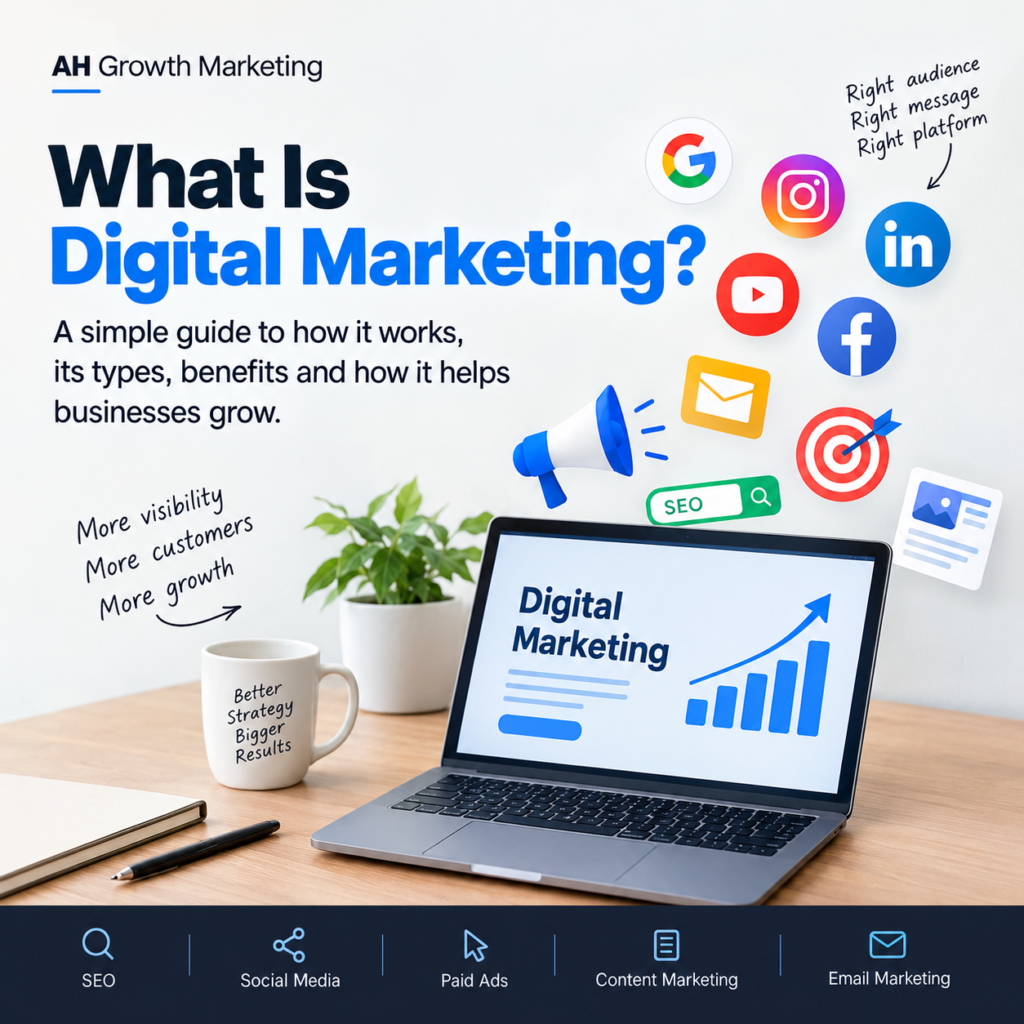
Digital marketing is the process of promoting products, services, or brands through online channels such as search engines, websites, social media, email, and paid advertising. It helps businesses reach relevant audiences, communicate their value, and generate potential customers.
However, creating an Instagram account and posting occasionally does not automatically make a business successful. Effective marketing requires a clear strategy, useful content, and consistent measurement.
In this guide, we will explain digital marketing, its major types, and how businesses can use digital marketing services to achieve practical results.
Table of Contents
What Is Digital Marketing?
How Does Digital Marketing Work?
Main Types of Digital Marketing
Benefits of Digital Marketing
What Are Digital Marketing Services?
Common Digital Marketing Mistakes
Frequently Asked Questions
Conclusion
What Is Digital Marketing?
Digital marketing refers to promoting a business using digital platforms and online communication channels.
These channels help companies connect with potential customers at different stages of the buying journey. Someone might discover a business through Google, follow it on Instagram, read its website, and eventually become a customer.
For example, a local clothing store could use SEO to appear in relevant search results, Instagram to showcase products, and Google Ads to attract people searching for specific clothing items.
Each channel serves a different purpose. The goal is to connect the right audience with the right message at the right time.
How Does Digital Marketing Work?
Digital marketing works by attracting relevant audiences, building interest, and encouraging people to take meaningful actions.
A typical process includes four steps.
Step 1: Identify your audience. Understand who your customers are, what they need, and what problems they want to solve.
Step 2: Choose suitable channels. Select platforms based on your audience and business goals.
Step 3: Create useful content. Publish information that answers questions, explains your products, or helps customers make decisions.
Step 4: Measure results. Track relevant metrics such as website traffic, qualified leads, conversion rates, and sales.
For instance, a digital marketing agency might publish an SEO guide that attracts business owners through Google. Some readers may explore its services and submit an enquiry.
That is a measurable path from content discovery to lead generation.
Main Types of Digital Marketing
1. Search Engine Optimization
Search Engine Optimization, or SEO, improves a website’s ability to appear in relevant unpaid search results.
It includes keyword research, helpful content, technical improvements, internal linking, and website usability.
For example, a dentist could create a useful page about dental implants to help people understand the treatment and find relevant information.
SEO requires patience. Publishing one article does not guarantee a first page ranking. Results depend on competition, content quality, website condition, and other factors.
2. Social Media Marketing
Social media marketing uses platforms such as Instagram, Facebook, LinkedIn, and YouTube to communicate with audiences.
Businesses can share educational content, demonstrate products, answer customer questions, and build relationships.
For example, a fitness trainer might publish workout demonstrations and nutrition tips to attract people interested in fitness services.
The objective is not simply to collect followers. It is to build a relevant audience and encourage meaningful engagement.
3. Search Engine Marketing and Paid Advertising
Paid advertising allows businesses to display ads to selected audiences or people searching for relevant products and services.
Google Ads is one example. Businesses can target relevant searches, direct users to landing pages, and measure campaign performance.
Suppose a company offers website development. It could run ads for relevant commercial searches and track how many visitors submit enquiries.
However, advertising spend alone does not guarantee sales. Targeting, offer quality, landing page design, and conversion tracking all matter.
4. Content Marketing
Content marketing involves creating useful information that attracts and educates a target audience.
Common formats include blog articles, videos, guides, case studies, and infographics.
For example, an accounting firm could publish a guide explaining common tax filing mistakes. Readers who find it useful may return when they need professional assistance.
Good content answers real questions instead of repeating keywords in the hope that search engines will be impressed.
5. Email Marketing
Email marketing helps businesses communicate with people who have chosen to receive their messages.
Companies can share useful resources, product updates, educational newsletters, and relevant offers.
For example, an online store might send customers product care instructions after a purchase.
Emails should provide value and respect consent. Sending unwanted messages to everyone with an email address is not a marketing strategy worth defending.
Benefits of Digital Marketing
Digital marketing offers several practical advantages.
Wider audience reach: Businesses can connect with potential customers beyond their immediate location.
Measurable performance: Analytics can help marketers understand traffic, enquiries, conversions, and campaign costs.
Audience targeting: Paid campaigns can focus on relevant locations, interests, searches, or other available targeting criteria.
Flexible budgets: Businesses can begin with selected channels and expand when performance supports further investment.
Improved customer communication: Websites, social platforms, and email help businesses answer questions and maintain relationships.
The benefits depend on the strategy. A poorly planned campaign can waste money, even when it uses sophisticated tools.
What Are Digital Marketing Services?
Digital marketing services are professional activities that help businesses improve their online visibility, reach customers, and support business objectives.
Common services include:
SEO and keyword research
Google Ads management
Social media marketing
Content creation and marketing
Website development
Conversion rate optimization
Analytics and performance reporting
A business does not necessarily need every service.
For example, a local service provider may prioritize local SEO and lead generation, while an online store may focus on product page optimization, paid advertising, and conversion tracking.
The right combination depends on the audience, competition, budget, and business goals.
Common Digital Marketing Mistakes
Many businesses struggle because they focus on activities instead of outcomes.
Expecting instant SEO results: Organic search visibility usually requires ongoing work.
Choosing platforms without audience research: Popularity does not guarantee relevance.
Ignoring website quality: Marketing can attract visitors, but a confusing website may prevent enquiries.
Tracking vanity metrics: Likes and impressions do not necessarily indicate business growth.
Failing to measure conversions: Without reliable tracking, it is difficult to determine which activities produce valuable results.
Start with clear objectives, measure meaningful actions, and improve your approach using evidence.
Frequently Asked Questions
Digital marketing means promoting products, services, or brands through online channels such as search engines, websites, social media, email, and online advertising.
The main types include SEO, social media marketing, paid advertising, content marketing, email marketing, and affiliate marketing.
It helps businesses reach relevant audiences, build brand awareness, generate leads, communicate with customers, and measure marketing performance.
The timeline depends on the channel and objective. Paid advertising may generate traffic quickly, while SEO and brand building often require sustained effort. Neither guarantees a particular outcome.
Conclusion
Digital marketing helps businesses connect with potential customers through online channels. From SEO and social media to paid advertising and email marketing, each channel can support a different stage of the customer journey.
The most effective approach starts with understanding your audience, choosing suitable channels, creating useful content, and measuring actual business outcomes.
You do not need to be everywhere online. You need to be where your customers are and give them a good reason to pay attention.
Want to improve your website visibility and attract relevant customers? Explore AH Growth Marketing for practical insights into SEO, performance marketing, and digital growth strategies.