
What Is Performance Marketing?
Introduction
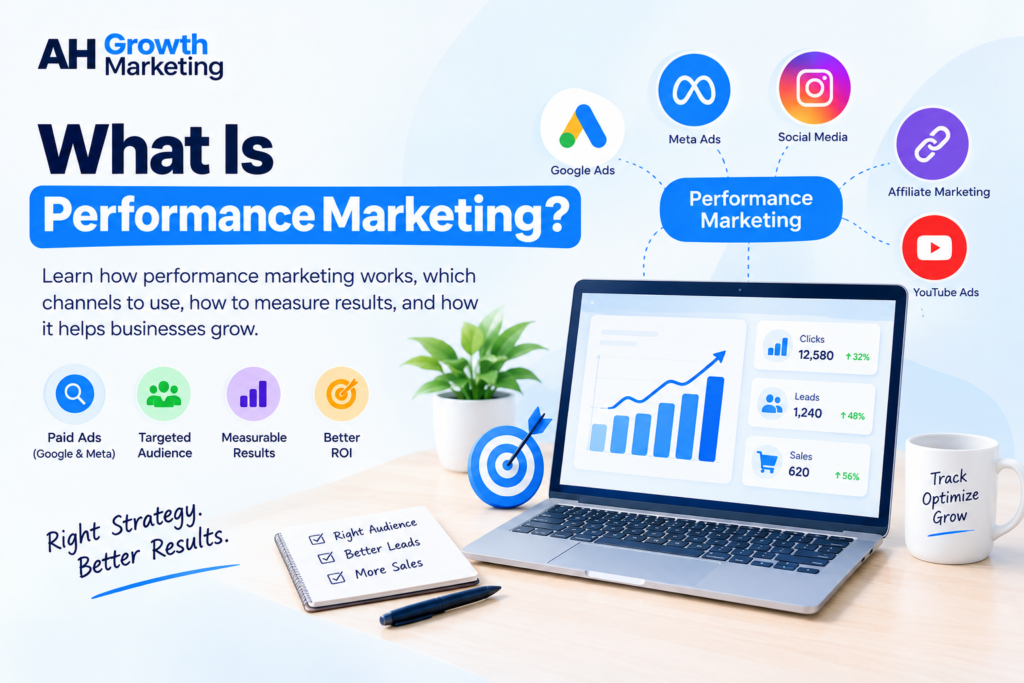
What is performance marketing, and why are so many businesses using it to promote their products and services? The answer is straightforward. Performance marketing focuses on measurable actions, such as clicks, leads, app installs, and sales. Instead of judging a campaign only by how many people saw an advertisement, businesses track what happened after people saw it.
Imagine spending ₹20,000 on online advertising. Your advertisement receives thousands of views, but nobody contacts your business or buys anything. Great visibility, terrible business results.
Performance marketing helps businesses connect advertising costs with specific goals. It uses data to measure results, compare campaigns, and make informed decisions about where to spend money.
However, tracking numbers does not automatically make a campaign successful. You still need the right audience, a relevant offer, convincing creative, and a website that turns visitors into customers.
Table of Contents
What Is Performance Marketing?
How Does Performance Marketing Work?
Main Performance Marketing Channels
Benefits of Performance Marketing
Performance Marketing Metrics You Should Know
Performance Marketing Services
Common Performance Marketing Mistakes
How to Build a Better Performance Marketing Strategy
Frequently Asked Questions
Conclusion
1. What Is Performance Marketing?
Performance marketing is a digital advertising approach in which businesses measure campaign success through defined actions or outcomes.
These actions may include:
Website clicks
Lead form submissions
Product purchases
App installations
Phone calls
Newsletter registrations
Businesses can use performance marketing across paid search, social media advertising, affiliate marketing, and other digital channels.
For example, an online clothing store might run advertisements on Google and Instagram. Rather than measuring success only through impressions, the store tracks product visits, purchases, cost per sale, and revenue generated.
The key idea is accountability. Advertisers should understand what they spend, what results they receive, and whether those results support their business goals.
One important detail: performance marketing does not always mean paying only when a sale happens. Many advertising platforms charge for clicks or impressions. The performance part comes from setting measurable goals and evaluating results against them.
2. How Does Performance Marketing Work?
A performance marketing campaign usually follows a series of steps.
Step 1: Set a Clear Goal
Start by deciding what you want the campaign to achieve.
A local service business might want qualified enquiries. An online store might want purchases. A mobile app company might focus on installations or paid subscriptions.
Avoid choosing goals simply because they look impressive in a report. A thousand clicks are not particularly useful if none of those visitors are interested in your offer.
Step 2: Choose the Right Audience and Channel
Identify who is most likely to take the desired action.
Google Search Ads can help reach people actively searching for a product or service. Meta Ads can help businesses reach relevant audiences through Facebook and Instagram.
The best channel depends on your audience, offer, competition, and budget.
Step 3: Create the Campaign
Prepare advertisements, landing pages, tracking, and conversion events.
For example, if your advertisement promises a free consultation, the landing page should explain the consultation and make booking easy. Sending visitors to an unrelated homepage creates unnecessary friction.
Step 4: Measure and Improve
Review campaign data regularly. Identify which advertisements, audiences, and landing pages produce useful results.
Then test improvements rather than changing everything at once. Otherwise, you may have no idea which change actually helped.
3. Main Performance Marketing Channels
Performance marketing uses several channels, each with different strengths.
| Channel | Best Used For | Example |
|---|---|---|
| Google Search Ads | Reaching people actively searching | Advertising SEO services |
| Meta Ads | Reaching relevant audiences on social platforms | Promoting a product on Facebook and Instagram |
| Affiliate Marketing | Working with partners who promote your offer | Paying a commission for tracked sales |
| Display Advertising | Building reach and supporting remarketing | Showing ads to relevant website visitors |
| Shopping Ads | Promoting products for online stores | Displaying product images and prices |
| Video Advertising | Reaching audiences through video content | Promoting a product through YouTube ads |
No channel guarantees success. A business should choose based on its goals and test performance with a sensible budget.
4. Benefits of Performance Marketing
Measurable Results
Businesses can track clicks, leads, purchases, and advertising costs. This makes it easier to understand whether a campaign is meeting its objectives.
Better Budget Decisions
Comparing campaign performance helps advertisers identify where additional investment may be worthwhile and where spending needs to be reduced.
Faster Feedback
Paid campaigns can generate useful data relatively quickly. Advertisers can use that information to test new messages, audiences, and landing pages.
Flexible Campaigns
Budgets, targeting, advertisements, and landing pages can be adjusted as performance changes.
Clearer Business Insights
Campaign data can reveal which products attract attention, which offers generate leads, and where potential customers leave the buying process.
Still, good reporting is not the same as profit. A campaign may generate many leads that never become customers. Businesses should evaluate lead quality and actual sales, not just the easiest numbers to celebrate.
5. Performance Marketing Metrics You Should Know
Understanding the numbers helps you make better decisions.
Cost Per Click (CPC): The average amount paid for each advertising click.
Formula: Total advertising spend ÷ Total clicks.
Cost Per Lead (CPL): The average advertising cost for each lead generated.
Formula: Total advertising spend ÷ Total leads.
Conversion Rate: The percentage of visitors who complete a desired action.
Formula: Conversions ÷ Total visitors × 100.
Customer Acquisition Cost (CAC): The cost of acquiring a customer, including the relevant marketing and sales expenses included in your calculation.
Return on Ad Spend (ROAS): The revenue attributed to advertising divided by advertising spend.
Formula: Attributed revenue ÷ Advertising spend.
For example, suppose a campaign spends ₹10,000 and generates ₹40,000 in attributed revenue. Its ROAS is 4x.
That does not automatically mean the business made ₹30,000 in profit. Product costs, fulfilment, salaries, taxes, agency fees, and other expenses may still need to be considered.
This is why experienced marketers look beyond attractive dashboard numbers.
6. What Are Performance Marketing Services?
Performance marketing services help businesses plan, run, measure, and improve campaigns designed to achieve specific outcomes.
These services may include:
Paid Advertising Management
Planning and managing campaigns on platforms such as Google Ads and Meta Ads.
Audience and Keyword Research
Identifying relevant search terms, audience groups, and customer needs before spending the advertising budget.
Landing Page Optimization
Improving page content, layout, forms, and calls to action to help visitors complete the intended action.
Conversion Tracking
Setting up appropriate tracking so businesses can understand which campaigns contribute to leads or sales.
Reporting and Optimization
Reviewing performance data, testing changes, and sharing clear reports that explain what is working and what needs attention.
When choosing a service provider, ask how results are measured, how often reports are shared, and whether conversion tracking is properly configured. You should understand where your budget goes without needing a marketing degree to interpret the report.
7. Common Performance Marketing Mistakes
Focusing Only on Clicks
Clicks show that someone visited your page. They do not prove that the person was a suitable customer.
Using Poor Landing Pages
An effective advertisement cannot compensate for a confusing website, unclear pricing, or a form that asks for unnecessary information.
Ignoring Conversion Tracking
Without reliable tracking, campaign reports may not accurately reflect leads or sales. Check that important events are recorded correctly before making major budget decisions.
Changing Campaigns Too Frequently
Making constant changes can make results difficult to interpret. Allow enough time and data for meaningful evaluation, while responding promptly to clear problems.
Expecting Guaranteed Results
Advertising performance depends on competition, audience demand, pricing, creative quality, and many other factors. Be cautious of anyone promising a fixed number of sales without understanding your business.
8. How to Build a Better Performance Marketing Strategy
Follow these practical steps to establish a stronger campaign.
Define one primary business goal.
Set a realistic budget based on your resources and expected customer value.
Choose an advertising channel that fits your audience.
Create a relevant advertisement and matching landing page.
Configure conversion tracking and test it before launching.
Monitor cost per lead, conversion rate, customer quality, and revenue.
Test one meaningful improvement at a time.
Review actual sales and profitability before increasing the budget.
For example, a digital marketing agency could test two different advertisements for its consultation service. One might focus on improving website visibility, while the other highlights lead generation. The agency can compare qualified enquiries and customer acquisition costs to determine which message works better.
This is an illustrative example, not a claim about actual campaign results. In real campaigns, record the budget, dates, tracking method, and outcomes before drawing conclusions.
9. Frequently Asked Questions
Performance marketing is digital advertising focused on measurable actions, such as clicks, leads, purchases, or app installations. Businesses use campaign data to evaluate results and improve spending decisions.
Digital marketing includes a broad range of online activities, such as SEO, content marketing, email marketing, and paid advertising. Performance marketing is an approach focused on measuring specific outcomes from marketing campaigns.
Common platforms include Google Ads, Meta Ads, affiliate networks, and other advertising platforms that support campaign measurement. The right choice depends on the target audience and business objective.
Yes. Small businesses can start with a manageable budget, focus on one clear goal, and test a campaign before investing more. Results depend on the offer, audience, competition, and execution.
No. It can help businesses measure and optimize advertising, but it cannot guarantee sales. Product demand, pricing, customer trust, competition, and the sales process all affect outcomes.
10. Conclusion
Performance marketing helps businesses make advertising decisions based on measurable results rather than guesswork. By setting clear goals, selecting suitable channels, tracking conversions, and testing improvements, businesses can understand how their campaigns contribute to growth.
However, the goal is not to collect impressive clicks or produce attractive reports. The goal is to generate meaningful business outcomes at a sustainable cost.
Start with a clear objective, reliable tracking, and a realistic budget. Measure what matters, learn from the data, and improve your campaigns step by step.
Want to understand how paid advertising and campaign measurement can support your business? Explore the performance marketing resources and services offered by AH Growth Marketing to learn more about campaign planning, conversion tracking, and optimization.