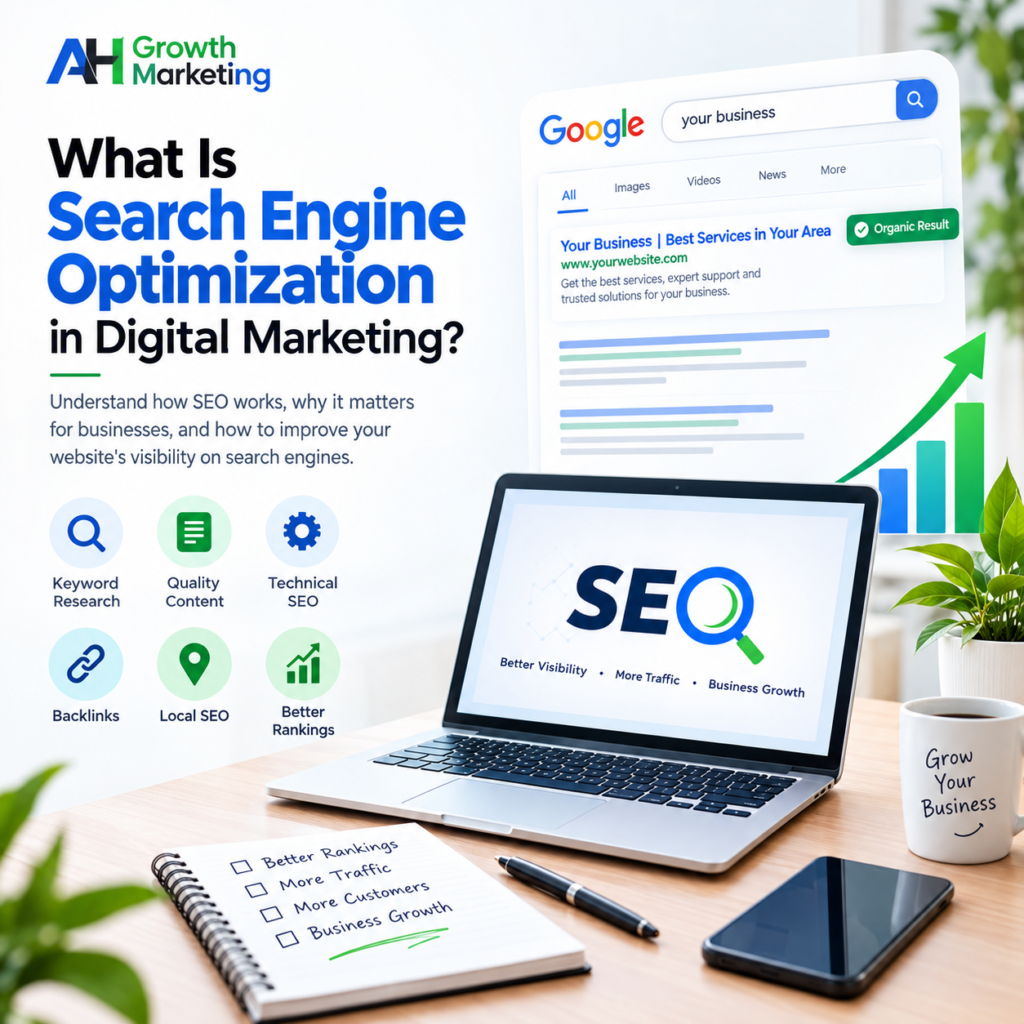
What Is Search Engine Optimization in Digital Marketing?
Introduction
Imagine having a great website, useful services, and competitive prices, but nobody can find you on Google. That is like opening a shop in the middle of nowhere and wondering why customers are not coming.
This is where search engine optimization in digital marketing becomes important. SEO helps improve a website’s visibility in unpaid search results, making it easier for people to discover relevant pages when they search online.
However, SEO is not about adding keywords everywhere and hoping Google gets impressed. It involves understanding what people search for, creating useful content, improving website performance, and helping search engines understand your pages.
Let’s look at how it works and how businesses can use it effectively.
Table of Contents
What Is Search Engine Optimization in Digital Marketing?
How Does SEO Work?
Types of SEO
Benefits of SEO for Businesses
Common SEO Mistakes
How to Improve Your Website’s SEO
Frequently Asked Questions
Conclusion
1. What Is Search Engine Optimization in Digital Marketing?
Search engine optimization, commonly called SEO, is the process of improving a website so that its pages can appear more prominently in relevant organic search results.
Organic results are unpaid listings on search engines such as Google. Unlike paid advertisements, you do not pay Google for each click on an organic result.
SEO in digital marketing helps businesses reach people who are already searching for information, products, or services related to their needs.
For example, if someone searches for “digital marketing agency in Rewa,” an agency with relevant content, a technically accessible website, and strong local signals may have an opportunity to appear in the search results.
SEO does not guarantee a particular ranking. Search engines consider many factors, and competitors are working to improve their own websites too.
2. How Does SEO Work?
SEO involves several activities that work together to improve a website’s search visibility.
Understanding Search Intent
Search intent means the reason behind a search.
Someone searching for “what is SEO” probably wants an explanation. Someone searching for “SEO agency near me” may be comparing service providers.
Your content should match what the searcher actually needs. Publishing a sales page for every informational keyword is not a clever strategy. It is a good way to disappoint visitors.
Keyword Research
Keyword research helps identify the words and phrases people use when searching online.
For example, a digital marketing agency might research terms such as:
Search engine optimization services
SEO in digital marketing
Local SEO services
How to improve Google rankings
Choose keywords based on relevance, intent, competition, and the type of page you can create to satisfy the search.
On Page SEO
On page SEO improves individual website pages. It includes descriptive titles, useful headings, relevant content, internal links, image alt text, and clear page structure.
Technical SEO
Technical SEO helps search engines access, crawl, and understand your website. Important areas include mobile usability, page indexing, site architecture, HTTPS, and page loading performance.
Off Page SEO
Off page SEO includes activities outside your website that can support its reputation and authority. Relevant backlinks, genuine brand mentions, and credible business references can contribute to a stronger online presence.
3. Types of SEO
Most SEO strategies include three main areas.
On Page SEO: Improving content, headings, titles, internal links, and page relevance.
Technical SEO: Making sure search engines can access and understand your website efficiently.
Off Page SEO: Building reputation through relevant links, brand mentions, and other credible external signals.
Local SEO is also important for businesses serving a specific geographic area. It includes maintaining accurate business details, improving your Google Business Profile, and earning genuine customer reviews.
The right combination depends on your business model, website condition, competition, and audience.
4. Benefits of SEO for Businesses
SEO can support business growth in several ways.
More Relevant Organic Traffic
Useful pages can attract people searching for information or services related to your business.
Better Brand Visibility
Appearing for relevant searches helps more potential customers discover your business.
Long Term Value
A well maintained page can continue attracting organic traffic after publication. However, rankings are not permanent. Competitors, search changes, and outdated content can affect performance.
Improved User Experience
Clear navigation, helpful information, mobile friendly design, and fast loading pages make a website easier to use.
More Business Opportunities
Relevant traffic can generate enquiries, bookings, or sales when the website provides a clear next step.
Remember, traffic alone does not prove success. A website receiving 10,000 irrelevant visits may generate fewer enquiries than one receiving 500 visits from the right audience.
5. Common SEO Mistakes
Some businesses waste time and money by focusing on the wrong activities.
Common mistakes include:
Stuffing keywords into every paragraph.
Publishing content without understanding search intent.
Buying low quality backlinks.
Ignoring mobile users.
Using duplicate or thin content.
Measuring success only through rankings.
Expecting SEO results within a few days.
SEO usually requires ongoing work. Meaningful progress may take several months, depending on competition, website condition, and the quality of implementation.
6. How to Improve Your Website's SEO
Start with practical steps rather than trying to fix everything at once.
Step 1: Review your website. Identify indexing issues, broken links, slow pages, and weak content.
Step 2: Research your audience. Find out what potential customers search for and what questions they need answered.
Step 3: Improve important pages. Write useful page titles, clear headings, relevant content, and descriptive internal links.
Step 4: Publish helpful content. Answer real customer questions with accurate information and practical examples.
Step 5: Measure performance. Use Google Search Console to monitor search impressions, clicks, queries, and indexing issues. Use analytics tools to understand what visitors do after arriving.
Step 6: Update your strategy. Review what works, improve weak pages, and address technical problems as they appear.
The key is consistency and evidence. Do not change your entire SEO strategy because one keyword moved down a position yesterday.
7. Frequently Asked Questions
It is the process of improving a website’s visibility in unpaid search results through relevant content, technical improvements, and other SEO activities.
SEO can help potential customers discover a business when they search for related products, services, or information.
The main types are on page SEO, technical SEO, and off page SEO. Local SEO is particularly useful for businesses targeting customers in specific locations.
SEO timelines vary. Some improvements may be noticed relatively quickly, while meaningful growth in organic visibility often takes several months or longer.
Neither is always better. SEO can build organic visibility over time, while paid advertising can provide faster access to targeted audiences. The right choice depends on your goals, budget, and timeline.
Conclusion
Search engine optimization in digital marketing helps businesses become easier to find when people search for relevant information, products, or services.
Effective SEO combines search intent, useful content, technical website health, and credible signals of authority. It requires regular review, not a one time keyword update.
Start by understanding your audience, improving your most important pages, and measuring meaningful outcomes. Better rankings are useful, but the real objective is attracting the right visitors and helping them take the next step.
Want to improve your website’s organic visibility? AH Growth Marketing can help you identify SEO opportunities, improve important website pages, and build a practical strategy around your business goals. Start by reviewing your current website and identifying the areas that need the most attention.